How work is organised affects the people doing it
The CIPD Good Work Index 2026 surveyed more than 5,000 UK workers. It found that 30% said their workloads were too high, 25% said work had a negative impact on their mental health and 20% said they always or often felt under excessive pressure.
The report also found strong associations between line management, leadership, opportunities to develop skills, meaningful work and five business-related outcomes including job satisfaction, willingness to recommend an employer, discretionary effort, innovative suggestions and intention to quit.
These are associations, not a promise that changing one workflow will improve wellbeing or performance. They do reinforce why the experience of the person/people doing the work belongs in a conversation about productivity and efficiency.
Source: CIPD Good Work Index 2026, published 4th August 2026.
The shape of UK small business
Department for Business and Trade estimates for the start of 2025 put the UK private-sector business population at 5.69 million. SMEs represented 99.85% of that population, accounted for 16.9 million jobs — 60% of private-sector employment — and generated an estimated £2.8 trillion, 51% of private-sector turnover.
SMEs are not inherently inefficient. The figures matter because much of the UK business population is made up of small organisations where time, people and internal capacity are limited.
Source: Department for Business and Trade, Business Population Estimates 2025.
Limited internal capacity
For many small businesses, a process has to be simple enough to run alongside the rest of the job.
Recurring admin can consume a lot of staff time
There is no single authoritative UK statistic for all time spent on administration, so specific examples are more useful than broad claims.
Department for Business and Trade research published in 2025 estimated that UK businesses were owed £26 billion in late payments at any given time. Businesses affected by late payment spent an average of 86 staff hours a year chasing it.
More recent official reporting shows improvement among large businesses: 15% of invoices were paid late in 2025, down from 25% in 2018. The direction is encouraging, while the earlier research still shows how much time manual follow-up can absorb when payment is delayed.
Sources: Department for Business and Trade, Late Payments Research, 2025; Office of the Small Business Commissioner, Payment Times Are Improving, 15th July 2026.
Practical improvement
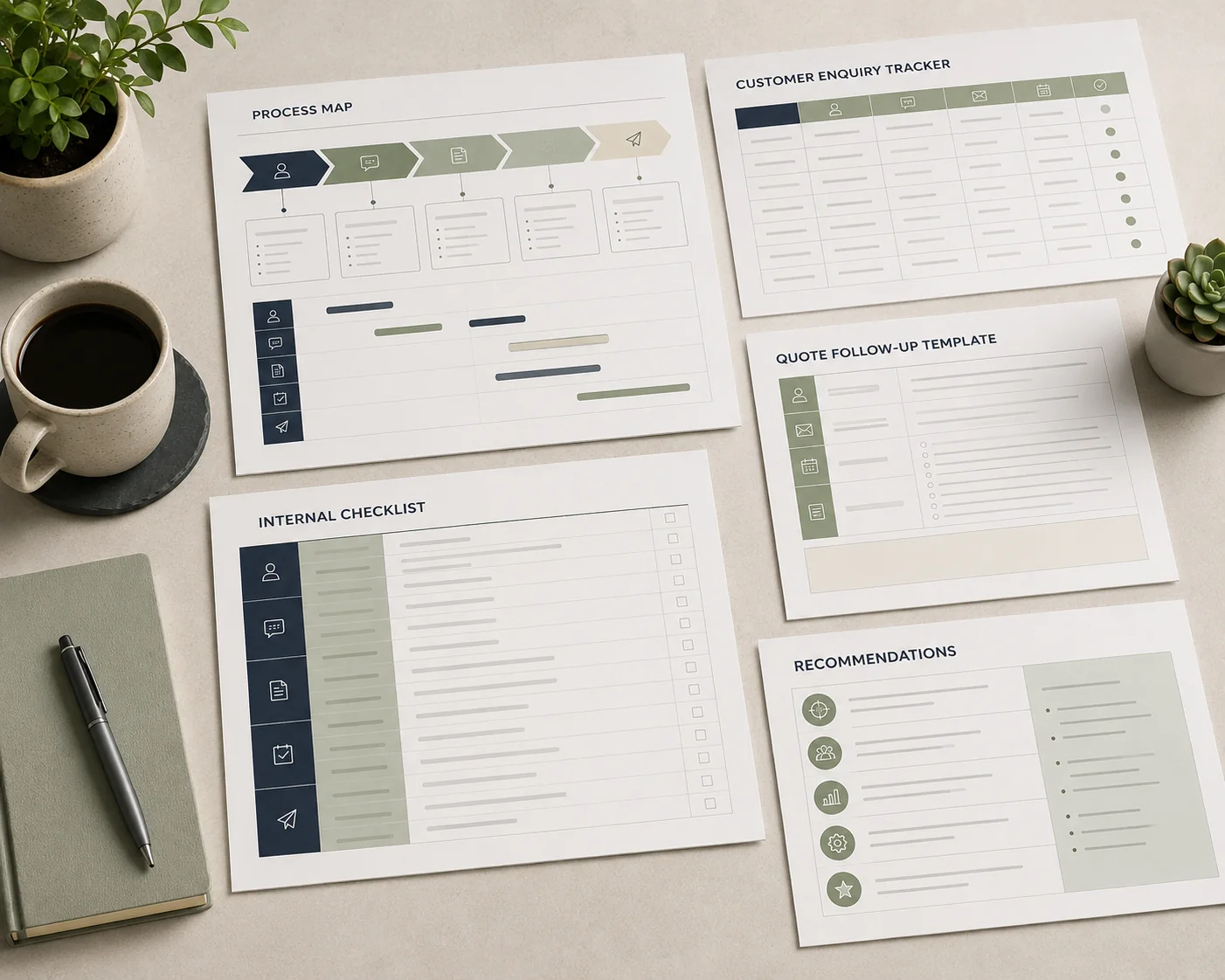
The useful change may be as ordinary as a better checklist, a simpler invoice process or one shared place for the next action.
Start with what you are noticing
What area of the business are you most keen to improve?
Digital tools do not automatically make a process efficient.
The UK Business Data Survey 2026 found that 86% of UK businesses handled some form of digitised data. Among businesses handling digitised data, only 8% said data use led to more efficient internal processes always or most of the time. The figure was 29% for large businesses, compared with 11% for small businesses, 10% for micro businesses and 7% for sole traders.
The survey suggests differences in time, skills, resources and infrastructure may help explain why larger organisations were more likely to report those gains.
A separate evaluation of the Made Smarter Adoption programme found high satisfaction with impartial expert advice and digital roadmaps, and 78% of participating manufacturing SMEs reported adopting industrial digital technologies after support. The more robust impact analysis did not yet identify statistically significant effects on turnover, employment or productivity.
Technology can be useful, but adoption on its own does not guarantee an operational or financial result.
Sources: Department for Science, Innovation and Technology, UK Business Data Survey 2026, published 18th June 2026; Department for Business and Trade, Made Smarter Adoption impact and process evaluation, published 30th July 2026.
Why the AI adoption figures differ
An ONS business survey reported 29% of businesses using at least one AI technology in June 2026. A British Chambers of Commerce study published in March 2026 reported 54% of its 668 UK business respondents actively adopting AI. A separate UK government survey, with fieldwork in 2025, found 16% current AI use among private-sector businesses with at least five employees.
These are not three estimates of exactly the same thing. They differ in timing, sample, business population, definitions and survey method.
Sources: ONS BICS, 2nd July 2026; BCC / University of Essex, March 2026; DSIT AI Adoption Research, February 2026.
From tool to workflow
A useful tool still needs a clear place in the process: what starts the action, who owns it and what happens next.

The AI implementation gap
In the UK government’s AI Adoption Research, lack of an identified organisational use was the most commonly reported barrier at 71%. Limited AI skills, expertise or knowledge was reported by 60%, while 29% reported complexity or difficulty integrating and scaling AI projects.
The survey covered private-sector businesses with at least five employees. Its barrier measures also combine past barriers reported by current users with current barriers reported by non-users, so the figures need that context.
The findings still point to a practical issue: having access to AI does not tell a business where it will help or how it should fit the work already being done.
Source: Department for Science, Innovation and Technology, AI Adoption Research, published 13th February 2026.
Start with the recurring process.
Look at what takes too long, what relies on memory and where information keeps being copied, lost or chased.
Reading the evidence carefully
The sources on this page cover different business populations, questions and time periods. Headline figures should be read with those differences in mind.
They provide context for recurring admin, technology use, AI adoption and job quality. A particular process still has to be examined on its own terms before deciding what, if anything, should change.
Why this matters for practical workflow improvement
Many small businesses already have email, spreadsheets, accounting software, forms, shared drives, customer systems or access to AI tools.
The harder part can be making those tools support a dependable way of working, so follow-up happens, information can be found and the next action stays visible.
The technology only helps if the process works better afterwards.